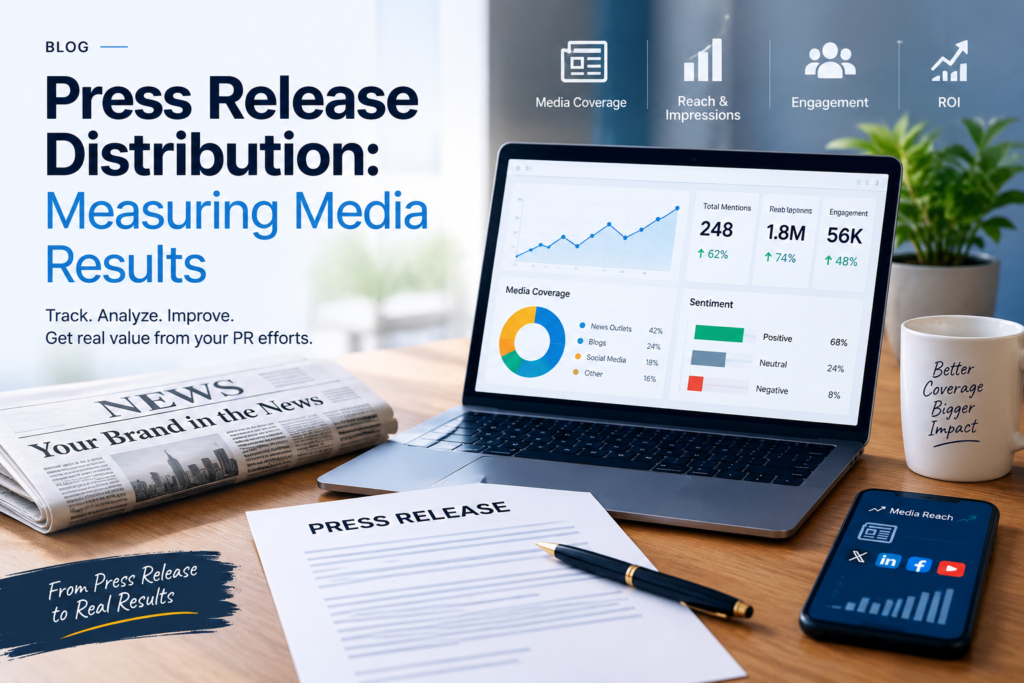
Press release distribution is an important part of public relations for businesses that want to communicate company updates, product launches, industry developments, and other newsworthy announcements. However, distributing a press release is only one step in an effective communication strategy. Understanding whether the announcement reached the right audience, attracted media attention, and generated meaningful engagement is equally important.
For businesses in the United States, measuring media results provides a practical way to evaluate public relations activities and make better decisions about future announcements. Rather than relying solely on the number of websites that publish a release, organizations can examine the quality of media coverage, audience reach, referral traffic, engagement, and other indicators that reflect their communication goals.
A structured measurement process also helps marketing and public relations teams explain the value of their work to company leaders. By identifying what worked, what did not, and why, businesses can improve their messaging and use communication resources more effectively.
Why Measuring Press Release Results Matters
A press release may be distributed to hundreds of media outlets, but distribution volume alone does not demonstrate success. Some announcements may receive limited attention, while others may generate relevant coverage in publications that reach an organization’s target audience.
Measurement helps businesses distinguish between activity and outcomes. Activity includes sending announcements, contacting journalists, and publishing content. Outcomes involve the results of those activities, such as media mentions, website visits, audience engagement, and qualified inquiries.
For example, a technology company announcing a new software feature might prioritize coverage in technology publications. A regional retailer may be more interested in local news coverage that reaches customers in its service area. Both organizations can benefit from press release distribution, but their definitions of success will differ.
Clear measurement also supports accountability. When businesses establish objectives before distributing an announcement, they can compare actual results with their expectations and identify opportunities for improvement.
1. Establish Clear Objectives Before Distribution
The first step in measuring media results is determining what the press release should accomplish. Without a defined objective, it becomes difficult to select meaningful metrics or decide whether the campaign achieved its purpose.
Common objectives include:
- Increasing awareness of a company, product, or service.
- Securing coverage in relevant news publications.
- Reaching a particular geographic or professional audience.
- Directing readers to a website or campaign landing page.
- Communicating important corporate developments.
- Supporting public trust through accurate and transparent information.
Each objective requires a suitable measurement approach. If the primary goal is media awareness, relevant publication mentions and estimated audience reach may be useful indicators. If the objective is to encourage readers to visit a website, referral traffic and landing-page engagement become more important.
Objectives should also be realistic and measurable. Instead of simply aiming to increase visibility, a company could seek coverage in selected industry publications or measure referral visits during a defined period after publication.
Setting expectations in advance makes the final evaluation more objective and reduces the temptation to judge success using whichever numbers look most impressive.
2. Track the Quality of Media Coverage
Media coverage is one of the most direct indicators of press release performance. However, counting every mention equally can create a misleading picture of the results.
A brief mention in an unrelated directory is not necessarily as valuable as a detailed article in a respected publication serving the intended audience. Therefore, businesses should assess both the quantity and quality of coverage.
Useful coverage indicators include:
Publication relevance: Determine whether the outlet serves the intended industry, location, or audience.
Editorial credibility: Consider the publication’s reputation, editorial standards, and relevance to the subject.
Message accuracy: Review whether the article communicates the announcement correctly and preserves important details.
Prominence: Identify whether the company or announcement receives meaningful attention within the article.
Sentiment and context: Examine how the organization is presented and whether the coverage is neutral, positive, or negative.
Businesses should also distinguish earned editorial coverage from automatically published press releases, syndicated copies, and paid placements. These activities serve different purposes and should not automatically be treated as equivalent achievements.
A coverage log can record publication names, URLs, publication dates, article types, key messages, and relevance ratings. This creates a reliable record for campaign reviews and helps teams identify which types of media relationships are most useful.
3. Measure Reach Without Overestimating Impact
Reach refers to the potential audience exposed to a press release or related media coverage. It can include a publication’s readership, website audience, newsletter subscribers, or other distribution channels.
Although reach can help estimate the scale of exposure, it does not establish how many people actually read an article or paid attention to the announcement. Published audience figures may also be estimates, cover broad audiences, or overlap across multiple publications.
For this reason, organizations should describe reach figures carefully and explain how they were calculated.
For example, adding the monthly audience figures of ten publications does not necessarily produce the number of unique people who encountered a press release. The same individual may read several of those publications, and many readers may never see the specific article.
A stronger approach combines potential reach with evidence of actual engagement. Relevant coverage, verified article views when available, referral visits, and audience interactions provide additional context.
Businesses should avoid presenting estimated exposure as confirmed readership. Transparent reporting makes campaign findings more credible and helps decision-makers understand the difference between potential visibility and demonstrated engagement.
4. Monitor Website Traffic and Visitor Behavior
Website analytics can help organizations determine whether media coverage encourages people to explore their online presence. This is particularly useful when a press release includes a link to a company website, product page, research report, or event registration page.
Several metrics can support this analysis:
- Referral traffic: Visits arriving from links on external websites.
- Landing-page sessions: Visits to a page associated with the announcement.
- Engaged sessions: Sessions that meet the engagement criteria used by the analytics platform.
- Engagement rate: The percentage of sessions classified as engaged.
- Conversion events: Completed actions such as registrations, downloads, or contact-form submissions.
Google Analytics 4, for example, can help businesses examine traffic sources, landing pages, and recorded conversion events. The exact information available depends on the site’s configuration and the tracking implemented.
Where possible, use campaign-specific tracking parameters on links that the organization controls. UTM parameters can help distinguish visits associated with a particular campaign from other traffic sources.
However, press release links may be copied, stripped of tracking parameters, or accessed through applications that do not preserve referral information. Some readers may also see an announcement and visit the company website later through a search engine or by typing the address directly.
Consequently, referral traffic is valuable evidence, but it does not capture every possible effect of media exposure. Businesses should interpret website data alongside coverage records and other campaign indicators.
5. Evaluate Audience Engagement
Audience engagement offers another way to understand how people respond to media coverage. Depending on the publication and available reporting, engagement may include article views, comments, shares, newsletter clicks, or interactions with related social media posts.
Not every media outlet makes these figures available. In addition, social media engagement may reflect discussion about a story rather than direct engagement with the original press release.
Businesses should therefore select engagement indicators that match their objectives and can be measured consistently.
For instance, a company announcing a public research report may monitor report downloads, visits to the research page, and discussion among relevant professional audiences. An organization promoting a community initiative might examine local media coverage, event registrations, and community responses.
Engagement should also be evaluated in context. A small number of interactions from a highly relevant audience may be more useful than a large volume of activity from people who have little connection to the announcement.
When engagement data is unavailable, organizations should acknowledge the limitation instead of assuming that publication automatically generated reader interest.
6. Understand Search Visibility and Brand Mentions
Press release distribution may contribute to online discoverability by making company announcements accessible through publications, search engines, and other digital channels. However, search visibility should be evaluated separately from direct media coverage.
Businesses can monitor whether relevant pages appear for branded searches, whether people search for the company or announced product, and whether coverage creates additional opportunities for audiences to discover the organization.
Search Console data can help website owners evaluate search impressions, clicks, and queries associated with their own websites. These metrics do not directly measure every external article or every brand mention, but they can provide useful supporting evidence.
Brand monitoring tools and manual searches can help identify articles that mention a company without linking to its website. Such mentions may demonstrate awareness even when they generate no measurable referral traffic.
It is important not to assume that a press release automatically improves search rankings or that every published copy provides an SEO benefit. Search performance depends on many factors, including content relevance, technical website quality, competition, and search engine systems.
A balanced evaluation considers search data as one part of a broader media measurement framework rather than treating rankings as the only measure of success.
7. Measure Conversions and Business Outcomes
Some press releases aim to produce outcomes beyond awareness. These may include product inquiries, event registrations, partnership discussions, report downloads, or other actions relevant to the organization.
Conversion tracking helps connect communication activities with these outcomes. Before distribution, businesses should identify which actions matter and ensure that appropriate tracking is in place.
For example, a company announcing an industry conference could monitor registration-page visits, completed registrations, and inquiries from prospective participants. A business publishing original research might track downloads and requests for additional information.
Where data permits, organizations can compare results with previous campaigns, historical averages, or other marketing channels. These comparisons should account for differences in audience, timing, campaign scope, and promotional support.
Attribution requires particular care. A person may encounter a press release, read a separate news article, see a social media post, and later respond to a direct email. Assigning the resulting conversion entirely to one activity may oversimplify the decision-making process.
Attribution models, customer surveys, and campaign tracking can provide useful evidence, but they have limitations. Businesses should distinguish between conversions directly associated with a tracked link and broader outcomes that may have been influenced by media exposure.
8. Calculate the Cost and Value of Media Results
Evaluating campaign costs helps organizations determine whether their communication resources are being used efficiently. Relevant expenses may include distribution fees, writing and editing time, media monitoring tools, creative production, and internal staff hours.
A basic cost-per-placement calculation divides the total campaign cost by the number of qualifying media placements. For example, a campaign costing $2,000 that generates ten relevant placements has a cost of $200 per placement.
This figure is useful only when the placements meet a consistent quality standard. Counting ten unrelated or automatically syndicated copies as equivalent to ten substantial editorial articles would distort the result.
Organizations may also calculate the cost per qualified referral visit, registration, or other tracked outcome. These figures can help compare campaigns with similar objectives and measurement methods.
Advertising value equivalency, which estimates what comparable advertising space might cost, is sometimes used in public relations reporting. However, it does not reliably establish the actual value of earned media. Editorial coverage differs from advertising in credibility, message control, placement, and audience response.
For stronger evaluation, businesses should combine cost indicators with coverage quality, engagement, and relevant business outcomes. This produces a more informative assessment than a single financial estimate.
9. Use a Consistent Reporting Framework
A standardized reporting process makes it easier to compare campaigns and communicate findings to company leaders.
Organizations can use a spreadsheet or media monitoring platform to record key results, including:
- Campaign objective and target audience.
- Distribution date and reporting period.
- Number of relevant editorial placements.
- Publication relevance and message accuracy.
- Potential reach, with the calculation method documented.
- Referral sessions and other website engagement indicators.
- Conversions or tracked actions.
- Total campaign cost and selected efficiency measures.
- Lessons and recommendations for future announcements.
Reports should distinguish confirmed results from estimates. They should also explain missing data, measurement limitations, and any important differences between campaigns.
For teams managing several announcements, resources such as vertex news wire may form part of their broader press release distribution research. Regardless of the distribution method, the measurement framework should remain aligned with the organization’s objectives and reporting standards.
A practical reporting schedule can include an initial review shortly after publication, followed by a later assessment to capture coverage and engagement that develop over time. The appropriate intervals depend on the campaign, publication schedules, and expected audience behavior.
10. Turn Campaign Findings Into Better Decisions
Measurement is most valuable when it informs future planning. After reviewing the results, public relations teams should identify which publications provided relevant coverage, which messages were communicated accurately, and which channels produced meaningful audience responses.
If an announcement receives extensive distribution but little relevant editorial attention, the team may need to reassess its newsworthiness, targeting, timing, or media outreach. If coverage is strong but referral traffic remains limited, the organization might examine the relevance of the audience, the placement of links, and the usefulness of the destination page.
Low engagement does not automatically mean that a campaign failed. Some corporate announcements serve compliance, transparency, or stakeholder communication objectives that are not expected to generate immediate website activity.
Similarly, a campaign with modest reach may still be valuable if it communicates essential information to the correct audience. Results should always be interpreted in relation to the original objective.
Maintaining records across multiple campaigns helps organizations identify patterns rather than drawing conclusions from a single announcement. Over time, these findings can improve media targeting, content development, distribution planning, and budget allocation.
Conclusion
Measuring press release distribution results requires more than counting publications or estimating audience exposure. Businesses need a structured approach that considers media coverage quality, potential reach, website traffic, audience engagement, search visibility, conversions, and campaign costs.
The most effective measurement framework begins with clear objectives and uses indicators that reflect the purpose of each announcement. It also distinguishes confirmed data from estimates, recognizes the limitations of attribution, and avoids overstating the business impact of media coverage.
For organizations operating in the United States, consistent reporting can make public relations decisions more transparent and evidence-based. By reviewing results carefully and applying the lessons to future announcements, businesses can develop more focused communication strategies and gain a clearer understanding of how press release distribution supports their broader goals.