A commercial building can have sprinklers, standpipes, and an extensive fire protection network, but these systems still depend on one critical factor: an adequate supply of water at the required pressure and flow. When the available municipal water supply cannot meet a building’s fire protection demands, a properly selected fire pump system can help bridge the gap.
For commercial facilities across Connecticut fire pump selection involves more than choosing a pump with a particular horsepower rating. Building height, water supply conditions, sprinkler demand, standpipe requirements, electrical infrastructure, and applicable fire codes all influence the right system.
Whether you manage a warehouse in Hartford, an office building in Stamford, a manufacturing facility in New Haven, or a multifamily commercial property elsewhere in the state, understanding how fire pump systems work can help you make informed equipment decisions.
This guide explains the major components, fire pump types, sizing considerations, code requirements, testing practices, and modernization opportunities that commercial property stakeholders should understand.
What Is a Fire Pump System?
A fire pump system is a dedicated water pumping arrangement designed to provide the pressure and flow required by a building’s fire protection systems. It draws water from an available source, such as a municipal water main or an on-site storage tank, and boosts the supply when necessary.
Fire pumps commonly support automatic sprinkler systems, standpipe systems, and other approved fire protection applications. They are particularly important in buildings where elevation, hydraulic demand, or limitations in the available water supply prevent the existing supply from delivering the required performance.
For example, a multistory commercial building may receive water from a municipal main, but the pressure available at street level might not be sufficient to serve the upper floors during a fire. A properly engineered fire pump can increase the available pressure to help meet the system’s calculated demand.
However, a fire pump does not create an unlimited water supply. Its performance depends on the available water source, suction conditions, pump characteristics, and the demands of the connected fire protection network.
The goal is to provide the required fire protection performance under the conditions established by the system design, not simply to maximize pressure.
Why Do Commercial Buildings in Connecticut Need Fire Pumps?
Connecticut has a diverse commercial building landscape, including downtown office towers, healthcare facilities, industrial properties, distribution centers, educational buildings, and large retail spaces. Each property presents different fire protection requirements.
A fire pump may be necessary when the available water supply cannot independently meet the required pressure and flow.
Several common situations can lead to this need.
1. Multistory buildings and elevated floors
Water pressure decreases as water moves upward through a building. The higher the floors, the greater the pressure needed to deliver the required flow at the discharge points.
A fire pump can help compensate for elevation-related pressure losses, allowing the designed sprinkler or standpipe system to receive adequate water.
2. Inadequate municipal water pressure
Municipal water supplies vary by location and operating conditions. A water supply that performs adequately for ordinary building use may not meet the more demanding requirements of a fire protection system.
A hydrant flow test and hydraulic analysis help engineers establish the available supply and determine whether additional pumping capacity is necessary.
3. Large warehouses and manufacturing facilities
Warehouses and industrial buildings may have substantial sprinkler demands because of their size, storage arrangements, commodity classifications, or specialized processes.
The fire pump must be selected to support the calculated demand of the applicable protection system while accounting for the available water supply.
4. Standpipe and combined sprinkler systems
Standpipe systems provide connections for firefighters to deliver water to designated locations within a building. Their pressure and flow requirements can differ from those of sprinkler systems.
Where sprinkler and standpipe systems share a water supply or pumping arrangement, engineers must evaluate their applicable hydraulic demands and the relevant code provisions.
5. Changes to existing commercial properties
Building renovations, additions, changes in occupancy, and modifications to storage arrangements can affect fire protection requirements.
An existing pump that once met the design demand may no longer be appropriate after a substantial change. Reviewing the system’s original design and current requirements can help determine whether equipment modifications or replacement are necessary.
Key Components of a Commercial Fire Pump System
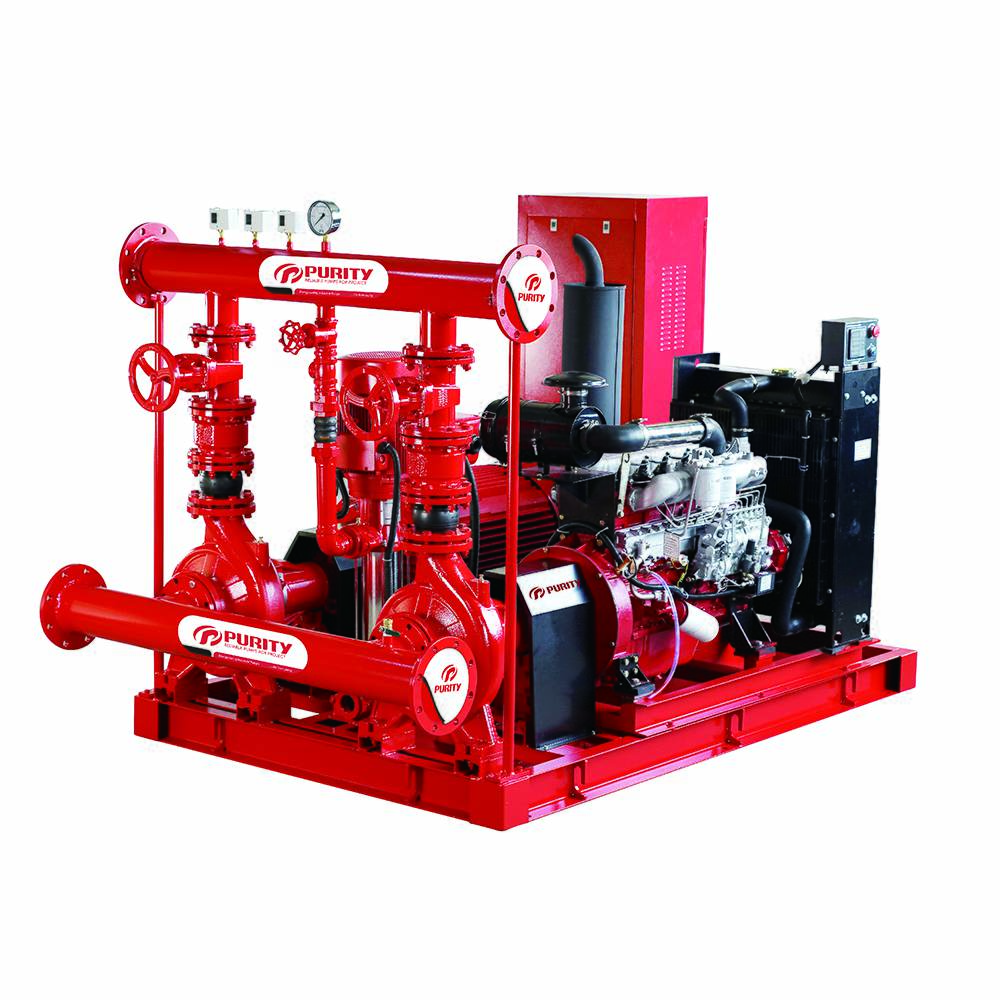
A fire pump is only one part of the complete assembly. Reliable operation depends on the interaction of several components.
Fire pump
The pump converts mechanical energy into hydraulic energy to increase water pressure. Its rated capacity is typically expressed in gallons per minute (GPM), while pressure performance is commonly evaluated in pounds per square inch (PSI).
The appropriate pump depends on the system’s calculated demand and the pressure available at its suction connection.
Driver or power source
The driver supplies the energy needed to operate the pump. Common options include an electric motor and a diesel engine.
The choice depends on project requirements, electrical service, reliability considerations, room layout, fuel arrangements, and applicable code provisions.
Fire pump controller
The controller manages the pump’s starting and operating functions. It responds to the designated starting conditions and provides operating or fault indications, depending on the equipment.
Fire pump controllers are specialized equipment. They must be selected and installed according to the pump arrangement, driver, listing requirements, and applicable standards.
Suction and discharge piping
Suction piping delivers water to the pump, while discharge piping carries pressurized water into the fire protection system.
Pipe sizing, fittings, valves, alignment, and hydraulic losses can influence performance. Poor suction conditions can also contribute to cavitation and damage.
Pressure gauges and sensing equipment
Pressure gauges and related sensing devices help operators assess the conditions at the pump’s suction and discharge connections. These readings are useful during commissioning, testing, and troubleshooting.
Water supply and supporting equipment
The water source may include a municipal connection, an on-site tank, or another approved arrangement. Depending on the installation, additional equipment may include a jockey pump, test header or flow meter, relief valves, and an emergency power arrangement.
Every component must be compatible with the complete fire protection design.
Types of Fire Pumps Used in Commercial Facilities
Different buildings and water supply conditions call for different pump configurations. The following are common options to evaluate with a qualified fire protection designer.
Horizontal split-case fire pumps
Horizontal split-case pumps are widely used in commercial and industrial applications that require substantial water flow.
Their casing design allows access to internal components for inspection and maintenance. These pumps may be suitable for larger facilities where the required capacity and available mechanical room space support this configuration.
Their suitability still depends on the pump curve, suction conditions, rated pressure, and the installation requirements.
Vertical inline fire pumps
Vertical inline pumps have a compact arrangement, with the suction and discharge connections positioned in line with the piping.
This configuration can be useful where mechanical room space is limited. Engineers must still verify the selected pump’s capacity, pressure performance, installation requirements, and approved application.
Vertical turbine fire pumps
Vertical turbine pumps can be considered when the water source requires a pump arrangement capable of drawing from a reservoir, tank, or other suitable source below the pump’s mounting level.
They can be useful for installations where conventional horizontal pump arrangements cannot meet the suction requirements.
Water-source conditions, submergence, available capacity, and the applicable listing and installation requirements must be evaluated carefully.
End-suction fire pumps
End-suction pumps have a relatively straightforward configuration and may suit certain commercial applications with compatible flow and pressure requirements.
Their suitability depends on the specific listed equipment, hydraulic design, and installation conditions rather than the building’s size alone.
Electric motor-driven fire pumps
Electric fire pumps use an electric motor as their driver. They may be appropriate where the electrical supply, service reliability, controller arrangement, and applicable requirements support the installation.
Designers must consider the electrical supply and required starting and operating conditions. Any emergency or standby power arrangement must be evaluated against the applicable code requirements.
Diesel engine-driven fire pumps
Diesel-driven fire pumps use an engine to operate the pump and may be considered when the project calls for an independent driver arrangement.
These installations require suitable fuel storage, ventilation, exhaust arrangements, engine cooling, and access for maintenance. The additional supporting equipment and room requirements should be considered early in the design process.
There is no universally best fire pump type. The correct selection is the configuration that satisfies the building’s hydraulic demand, water supply conditions, equipment requirements, and applicable fire protection codes.