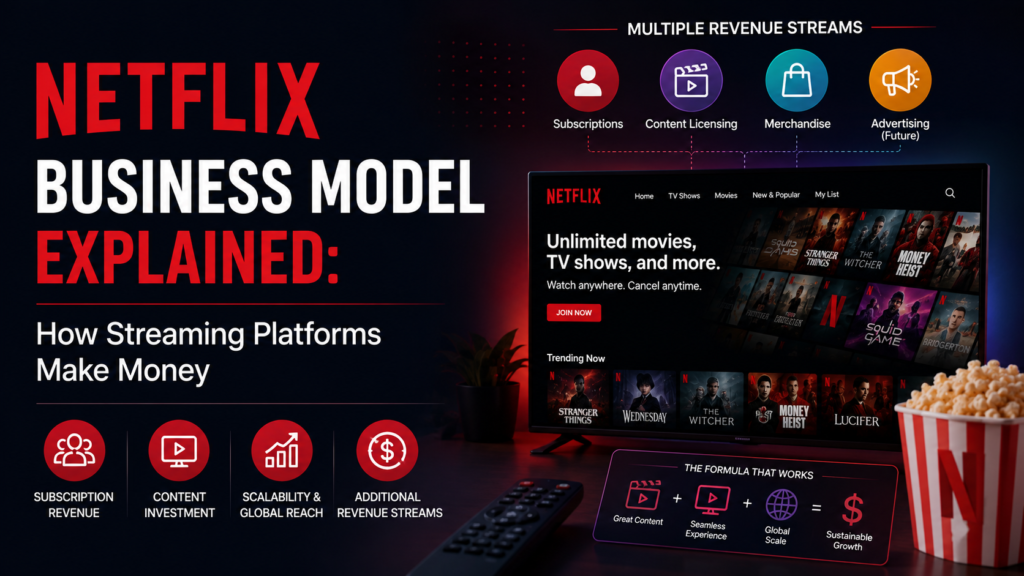
Netflix has transformed the entertainment industry by changing how people watch movies, TV shows, documentaries, and original content. Instead of relying primarily on traditional television distribution, Netflix built a digital streaming business around internet-based content delivery and recurring customer subscriptions.
Understanding the Netflix business model can provide valuable insights for entrepreneurs, media companies, content creators, and businesses planning to launch their own streaming service.
Netflix is not simply a video streaming application. Its business combines content creation, technology, customer subscriptions, personalization, data analytics, global distribution, and multiple revenue streams.
This article explains how the Netflix business model works, how streaming platforms generate revenue, and how businesses can apply similar strategies when building an OTT platform.
What Is the Netflix Business Model?
The Netflix business model is primarily based on providing customers with access to a large library of digital content in exchange for recurring subscription payments.
Instead of charging users separately for every movie or episode, Netflix offers subscription plans that provide access to its content library based on the selected plan.
The basic concept can be represented as:
Content Creation & Licensing → OTT Platform → Subscribers → Monthly Revenue → Content & Technology Investment
This recurring-revenue approach is one of the key reasons subscription streaming has become such an important digital business model.
Netflix has also expanded its monetization approach by introducing an advertising-supported plan in selected markets, demonstrating how streaming companies can combine subscription revenue with advertising.
How Does Netflix Make Money?
The Netflix business model primarily relies on subscription revenue, while advertising has become an additional monetization channel.
The major components include:
- Subscription plans
- Advertising-supported subscriptions
- Original content
- Licensed content
- Global market expansion
- Additional digital entertainment initiatives
Let’s look at these components in more detail.
1. Subscription Revenue
Subscription revenue is the foundation of Netflix’s business.
Users pay a recurring fee to access Netflix’s content library. Depending on the market and available plans, customers may receive different features such as video quality, supported devices, or advertising options.
The subscription business model provides Netflix with recurring revenue rather than relying entirely on individual content purchases.
For a streaming business, recurring revenue can make financial planning and customer-value analysis easier because the company can monitor metrics such as:
- Number of subscribers
- Monthly recurring revenue
- Customer retention
- Churn rate
- Average revenue per user
- Customer lifetime value
2. Advertising-Supported Streaming
Netflix has also introduced an advertising-supported subscription option in various markets.
This approach combines two important revenue concepts:
Subscription Revenue + Advertising Revenue
Users pay for a lower-priced subscription while advertisers pay to reach the platform’s audience.
This represents an important development in the modern streaming business model because businesses don’t necessarily have to choose between subscriptions and advertising.
An OTT platform can potentially offer:
- Premium ad-free subscriptions
- Lower-cost ad-supported subscriptions
- Free ad-supported content
- Premium pay-per-view content
This creates opportunities to target different audience segments.
3. Original Content
Netflix has invested heavily in original movies, series, documentaries, and other exclusive programming.
Original content helps streaming businesses differentiate themselves from competitors.
If the same content is available on multiple platforms, customers may have less reason to choose one service over another. Exclusive content can create a stronger reason for users to subscribe and remain subscribed.
Original content can therefore contribute to:
- Subscriber acquisition
- Customer retention
- Brand differentiation
- Global expansion
- Increased viewing time
However, producing high-quality original content requires significant investment, making content strategy a critical component of the streaming business.
4. Licensed Content
In addition to original programming, streaming platforms can license movies, television shows, documentaries, and other content from third-party content owners.
Licensing allows a platform to expand its content library without producing every piece of content internally.
A typical content strategy may therefore combine:
Original Content + Licensed Content + Regional Content
This combination can help streaming platforms serve different audience preferences.
For businesses launching a new streaming service, content licensing can be an important consideration because content availability can directly affect customer acquisition and retention.
5. Global Expansion
Another important component of the Netflix business model is international expansion.
Digital streaming allows companies to reach audiences across geographic markets without building traditional physical distribution networks.
However, global streaming requires more than simply making a platform available in another country.
Streaming companies may need to consider:
- Local content
- Language support
- Subtitles
- Payment methods
- Pricing
- Local regulations
- Content licensing
- Customer preferences
Regional content can be particularly valuable because audiences often prefer stories, languages, and cultural experiences that are relevant to them.
6. Personalized Recommendations
Netflix is also known for its use of personalization and recommendation technology.
A streaming platform can analyze user behavior such as:
- Viewing history
- Watch time
- Search behavior
- Content preferences
- Genres
- Device usage
- Interaction patterns
These insights can help the platform recommend relevant content.
Personalization can improve content discovery and potentially increase engagement.
For a modern OTT platform, recommendation engines can therefore become an important part of the user experience.
7. Data-Driven Content Strategy
Streaming platforms can collect large amounts of behavioral data.
This information can help businesses understand:
- Which content users watch
- When users watch
- Where viewers stop watching
- Which genres perform well
- Which content attracts new users
- Which content keeps subscribers engaged
These insights can support decisions related to content acquisition, production, marketing, and customer retention.
However, businesses must ensure that data collection and processing follow applicable privacy and security requirements.
What Is OTT Monetization?
OTT monetization refers to the different ways a streaming platform generates revenue from its digital content and audience.
The most common OTT monetization models include:
SVOD
Subscription Video on Demand allows users to pay a recurring subscription fee.
AVOD
Advertising Video on Demand allows users to access content while the platform generates revenue through advertising.
TVOD
Transactional Video on Demand allows customers to pay for individual videos, movies, events, or other premium content.
Hybrid Monetization
A platform can combine two or more models.
For example:
SVOD + AVOD + TVOD
A hybrid strategy can help streaming businesses reach different customer segments and diversify revenue.
Netflix Business Model vs Traditional TV
The Netflix approach differs significantly from traditional television.
| Feature | Traditional TV | Streaming Business |
|---|---|---|
| Distribution | Cable/Satellite | Internet |
| Viewing | Scheduled | On-demand |
| Revenue | Ads/Subscriptions | Subscriptions/Ads/Transactions |
| Personalization | Limited | Data-driven |
| Device Flexibility | Limited | Multiple devices |
| Content Access | Fixed schedule | On-demand |
| Analytics | Limited | Detailed digital analytics |
Streaming platforms provide greater flexibility because viewers can choose what they want to watch and when they want to watch it.
Key Components of a Netflix-Like Business Model
Businesses planning to build a streaming service can learn several lessons from Netflix.
1. Strong Content Strategy
Content remains one of the most important factors in streaming.
A platform should identify its target audience and develop or acquire content that matches their interests.
2. Recurring Revenue
The subscription business model can provide predictable recurring revenue when supported by strong customer retention.
3. Personalization
Recommendation engines can help users discover content that matches their interests.
4. Multi-Device Accessibility
A modern streaming service should provide a consistent experience across:
- Web
- Android
- iOS
- Smart TVs
- Tablets
- Connected devices
5. Scalable Infrastructure
The platform should be capable of handling increasing numbers of viewers without significantly compromising streaming performance.
6. Analytics
Analytics can help businesses understand customer behavior and improve content and monetization strategies.
How an OTT Platform Can Use the Netflix Approach
Businesses don’t need to replicate Netflix entirely to learn from its strategy.
An OTT platform can implement selected elements of the Netflix approach based on its audience, budget, content strategy, and business objectives.
For example, a niche streaming service could focus on:
Specific Audience → Specialized Content → Subscription → Personalized Recommendations → Customer Retention
A sports streaming platform might focus on live events and premium subscriptions.
An education platform might offer courses through a subscription business model.
A creator platform could combine subscriptions with transactional content.
A corporate training platform could offer organizations recurring access to a private video library.
Technology Required for a Netflix-Like Streaming Platform
Building a modern streaming platform requires multiple technology components.
Video Content Management
Allows administrators to upload, organize, manage, and publish content.
Video Encoding and Transcoding
Converts videos into formats and quality levels suitable for different devices and network conditions.
Content Delivery Network
Helps deliver video efficiently to viewers across geographic locations.
Video Player
Provides the interface through which users watch content.
Subscriber Management
Handles accounts, profiles, subscriptions, and access permissions.
Payment Integration
Supports recurring payments, one-time transactions, and other monetization options.
Recommendation Engine
Analyzes user behavior to provide personalized content suggestions.
Analytics
Provides information about viewing behavior, engagement, subscribers, and revenue.
Security
Protects content and user information through authentication, authorization, encryption, and other security mechanisms.
How Streaming Platforms Reduce Customer Churn
Subscriber retention is extremely important for a subscription-based streaming business.
A platform can use several strategies to improve retention:
- Consistently publish new content
- Provide personalized recommendations
- Offer multiple subscription plans
- Improve streaming quality
- Support multiple devices
- Provide an easy-to-use interface
- Understand customer behavior
- Offer relevant promotions
The objective is to continuously provide enough value for customers to maintain their subscriptions.
Important Metrics for a Streaming Business
A successful streaming business should monitor key performance indicators.
Subscriber Growth
Measures how quickly the platform is acquiring new customers.
Churn Rate
Shows how many subscribers cancel their subscriptions.
Customer Lifetime Value
Estimates the long-term value generated by a customer.
Average Revenue Per User
Helps measure revenue generated per customer.
Watch Time
Shows how much time users spend consuming content.
Content Engagement
Helps identify which videos, shows, or categories perform best.
Customer Acquisition Cost
Measures how much it costs to acquire a new subscriber.
These metrics help businesses evaluate whether their streaming business model is sustainable.
Lessons Businesses Can Learn From the Netflix Business Model
The Netflix business model provides several useful lessons for businesses planning to enter the streaming industry.
Focus on the Audience
Understand what your target audience wants before investing heavily in content.
Build a Strong Content Library
A combination of original, licensed, and specialized content can strengthen the platform.
Create Multiple Revenue Opportunities
Subscriptions can be combined with advertising or transactional monetization where appropriate.
Invest in User Experience
Fast playback, easy navigation, personalized recommendations, and multi-device access can improve customer satisfaction.
Use Data Responsibly
Analytics can provide valuable insights, but businesses should implement appropriate privacy and security practices.
Build for Scale
Your technology infrastructure should be capable of supporting audience growth.
Future of Streaming Business Models
The streaming industry continues to evolve.
Future streaming businesses are likely to experiment with:
- AI-powered recommendations
- AI content discovery
- AI customer support
- Interactive streaming
- Personalized advertising
- Hybrid monetization
- Live commerce
- AI-powered content management
- Multi-platform experiences
- More specialized niche streaming services
AI can also help streaming platforms automate metadata creation, content categorization, customer support, marketing workflows, and audience analysis.
This means the next generation of streaming businesses will likely combine content, technology, data, AI, and flexible monetization models.
Conclusion
The Netflix business model demonstrates how a digital streaming company can combine recurring subscriptions, advertising, original content, licensed programming, personalization, analytics, and global distribution to build a scalable entertainment business.
For entrepreneurs and businesses planning to launch their own streaming service, Netflix provides a useful example, but there is no single model that works for every business.
The right approach depends on the target audience, content strategy, market, pricing, and available technology.
A modern OTT platform can support multiple monetization strategies, including subscriptions, advertising, transactions, and hybrid models. By combining the right streaming business model with engaging content, scalable technology, personalized experiences, and strong customer retention strategies, businesses can build sustainable digital streaming services.
Ultimately, successful OTT monetization is not just about charging users. It is about continuously delivering enough value to attract viewers, engage them, and turn them into long-term customers.
Frequently Asked Questions
What is the Netflix business model?
The Netflix business model is primarily based on recurring subscriptions that provide customers with access to a large library of digital content. Netflix has also expanded into advertising-supported subscriptions.
How does Netflix make money?
Netflix primarily generates revenue through subscription fees, with advertising providing an additional revenue stream in markets where its ad-supported plan is available.
What is a streaming business model?
A streaming business model defines how a streaming service delivers content to users and generates revenue. Common models include SVOD, AVOD, TVOD, and hybrid approaches.
What is OTT monetization?
OTT monetization refers to the methods streaming platforms use to generate revenue from digital content, including subscriptions, advertising, transactions, and hybrid models.
Can I build a Netflix-like OTT platform?
Yes. Businesses can build customized OTT platforms with features such as video-on-demand, live streaming, subscriber management, payment integration, recommendation engines, analytics, multi-device applications, and content security.
Which monetization model is best for an OTT platform?
There is no universal model. SVOD can work well for recurring revenue, AVOD can help maximize audience reach, and TVOD can be suitable for premium individual content. A hybrid model can combine multiple revenue streams.