Generic Doesn’t Mean Inferior—Here’s Why Millions of Patients Trust Generic Medicines
“If it’s so much cheaper, is it really as good?”
It’s one of the most common questions patients ask when they’re offered a generic medication instead of a well-known brand.
The assumption is understandable. In almost every other industry, a lower price often signals lower quality. A luxury watch costs more than a basic one. A premium smartphone costs more than an entry-level model. Expensive products are often perceived as better.
Healthcare, however, doesn’t always follow the same rules.
In fact, millions of prescriptions filled every year are for generic medicines—not because they’re “second-best,” but because they offer the same therapeutic benefits at a significantly lower cost. Physicians prescribe them, pharmacists recommend them, hospitals rely on them, and healthcare systems around the world use them every day.
So why does the myth that “generic means inferior” still exist?
Let’s separate perception from reality.
Understanding What a Generic Medicine Really Is
Before discussing quality, it’s important to understand what the term generic actually means.
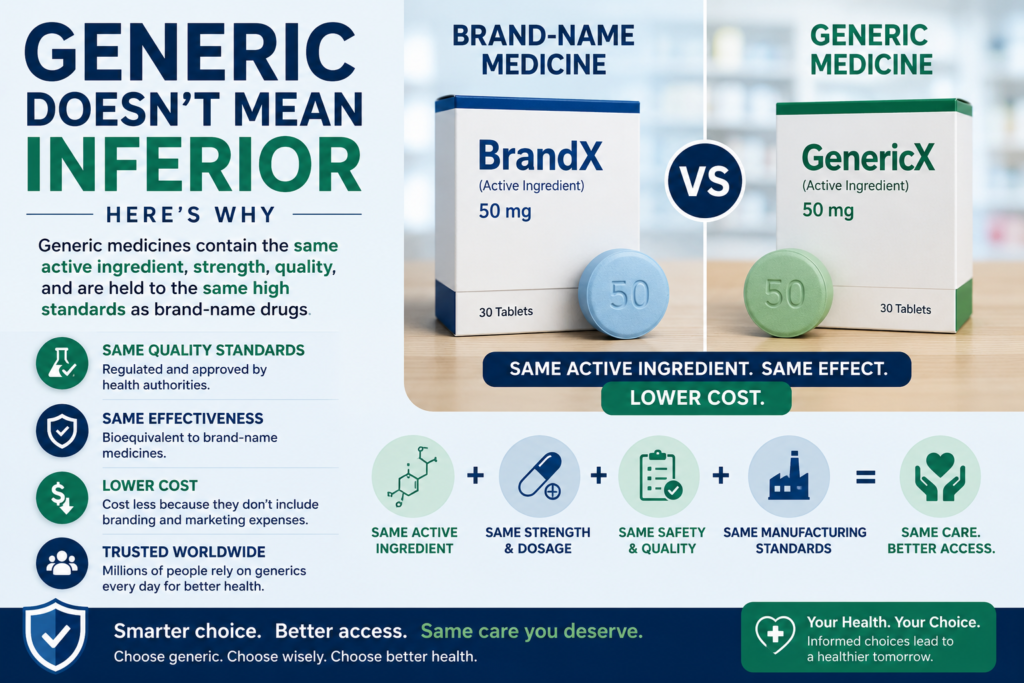
A generic medicine is a medication developed after the patent protection of a brand-name drug expires. It contains the same active pharmaceutical ingredient, is intended to treat the same medical condition, and is manufactured in the same dosage form and strength as its branded counterpart.
That means if a branded medicine contains a specific active ingredient designed to treat a condition, its generic version contains that same ingredient in the same amount.
The primary differences usually involve factors such as:
- Brand name
- Packaging
- Tablet shape or color
- Inactive ingredients (such as fillers or coatings)
The ingredient responsible for treating the condition remains the same.
This distinction is often misunderstood, leading many patients to assume that a lower price reflects a lower-quality product.
Why Are Generic Medicines Less Expensive?
This is perhaps the biggest source of confusion.
Many people believe generic medicines are cheaper because manufacturers cut corners.
In reality, the biggest reason is economics—not quality.
Developing a brand-new medication is one of the most expensive processes in healthcare.
Before a medicine ever reaches pharmacy shelves, the original manufacturer may invest years in:
- Drug discovery
- Laboratory research
- Clinical trials
- Regulatory submissions
- Manufacturing development
- Marketing and education
These costs can amount to billions of dollars and are reflected in the final price of the branded medication.
Once patent exclusivity ends, other manufacturers can produce equivalent versions without repeating the original discovery and development process.
Because those initial investments have already been made, generic manufacturers can focus on production efficiency rather than recovering decades of research costs.
The lower price is largely a result of lower development costs—not reduced effectiveness.
Do Generic Medicines Have to Meet Quality Standards?
Yes and a very good example of such medications can be today’s popular generic ED medications such as Kamagra and Cenforce.
This is one of the most important facts patients should understand.
Generic medicines are expected to meet rigorous regulatory standards before they can be marketed. While the exact requirements vary by country and regulatory authority, manufacturers must demonstrate that their products meet established standards for quality, consistency, manufacturing, and performance.
Facilities are subject to inspections, manufacturing processes are evaluated, and products are tested to help ensure they meet applicable regulatory expectations.
In other words, generic medicines are not exempt from quality requirements simply because they are less expensive.
The Science Behind Bioequivalence
One term you’ll often encounter when discussing generic medicines is bioequivalence.
Although it sounds technical, the concept is straightforward.
Bioequivalence means that a generic medicine is designed to deliver its active ingredient into the body in a way that is comparable to the reference brand product.
Researchers evaluate how the medicine is absorbed and becomes available in the body. If the generic meets accepted regulatory standards, it may be approved as an equivalent.
This process helps ensure that patients receive the intended therapeutic effect when using an approved generic medication.
Why the Myth Persists
If generic medicines are widely used and carefully regulated, why do some patients remain skeptical?
Several factors contribute to this perception.
Price Psychology
Consumers naturally associate higher prices with higher quality.
When one medication costs several times more than another, it’s easy to assume the more expensive option must be better—even when both contain the same active ingredient.
Brand Recognition
Brand-name medicines often benefit from years of advertising and public awareness.
Patients become familiar with these names and may feel more comfortable choosing something they’ve seen advertised or heard about for years.
Generics rarely receive the same level of marketing, despite being widely used in clinical practice.
Visual Differences
Generic tablets may differ in color, shape, size, or packaging.
These cosmetic differences can create the impression that the medicines themselves are fundamentally different, even though the therapeutic ingredient remains the same.
Why Doctors and Pharmacists Frequently Recommend Generics
Healthcare professionals often recommend generic medicines for a simple reason:
They help improve access to treatment.
When medications become more affordable, patients are generally more likely to begin treatment, continue therapy as prescribed, and maintain long-term adherence when appropriate.
For chronic conditions that require ongoing medication, affordability can play an important role in supporting consistent treatment.
This is one reason generic medicines have become an integral part of modern healthcare systems worldwide.
India’s Growing Contribution to Generic Medicines
When discussing generic medicines, it’s impossible to overlook India’s role in the global pharmaceutical industry.
Over the past few decades, India has become one of the world’s largest manufacturers of generic medications, supplying medicines to countries across North America, Europe, Africa, Asia, and Latin America.
Its pharmaceutical sector produces treatments for a wide variety of therapeutic areas, helping improve access to medications for millions of patients around the world.
This global presence reflects the important role generic manufacturing plays in expanding healthcare access.
Choosing Generic Medicines Wisely
Although generic medicines offer many advantages, it’s still important to purchase medications responsibly.
Patients should:
- Buy from reputable and transparent providers.
- Review product information carefully.
- Follow prescribed dosage instructions.
- Discuss treatment questions with a qualified healthcare professional.
- Avoid purchasing medicines from unverified or suspicious sources.
Affordability should always be accompanied by informed decision-making.
The Bigger Picture: Access to Healthcare
The discussion surrounding generic medicines extends beyond cost.
At its core, it’s about access.
Affordable medicines can help reduce financial barriers that might otherwise make treatment difficult for some patients.
As healthcare costs continue to influence treatment decisions, generic medicines play an increasingly important role in supporting broader access to essential therapies.
For many healthcare systems around the world, they are not an alternative—they are a cornerstone of modern medicine.
Final Thoughts
The idea that “generic means inferior” is one of the most persistent myths in healthcare.
In reality, generic medicines exist because scientific innovation, regulatory oversight, and market competition make it possible to provide effective treatment options after brand-name patents expire.
Their lower price reflects a different business model—not necessarily a different standard of care.
For millions of patients, generic medicines have become an important way to access treatment while managing healthcare costs responsibly.
The next time someone says, “It’s generic, so it can’t be as good,” remember this:
A lower price doesn’t automatically mean lower quality. Sometimes, it simply means you’re paying for the medicine—not the marketing, the patent, or the years of research that came before it.