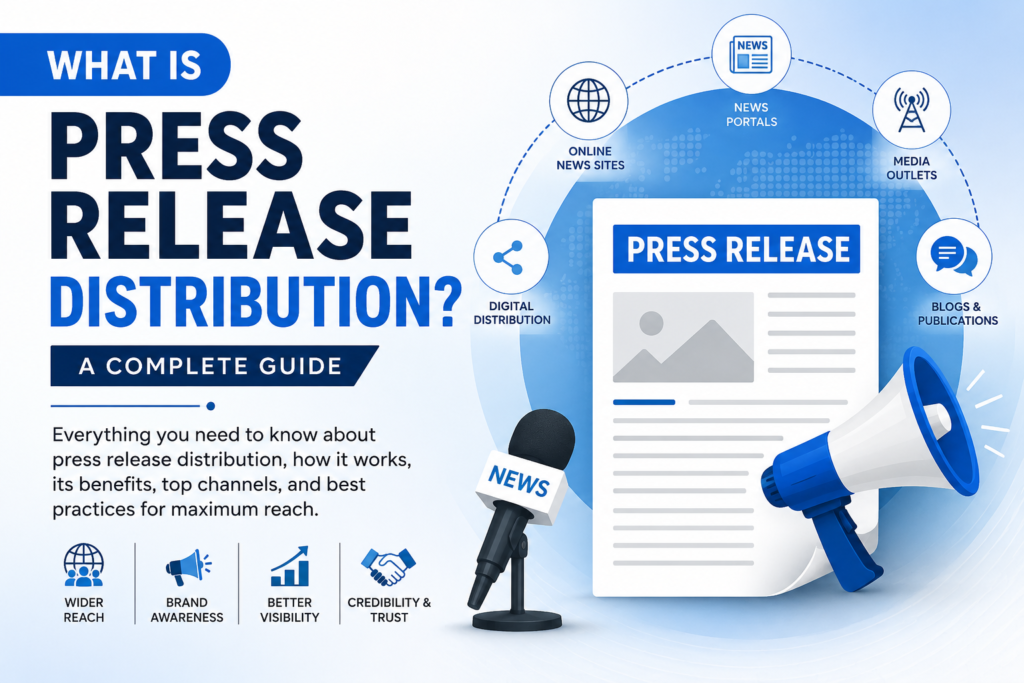
Press releases remain an important communication tool for businesses, nonprofits, government organizations, and other institutions that need to share significant news with journalists and the public. However, writing a press release is only one part of the process. Getting that announcement in front of relevant media outlets, journalists, industry publications, and online audiences requires an effective distribution strategy.
This is where press release distribution comes into play.
Press release distribution is the process of delivering a completed news release to selected media contacts, news organizations, online publications, industry platforms, and other channels that may publish or report on the announcement. Depending on the distribution method, a release may reach a local audience, a national U.S. audience, or readers across multiple countries.
For organizations considering online press release distribution, understanding how the process works, what distribution services actually provide, and what results can realistically be expected is essential.
What Is Press Release Distribution?
Press release distribution is the organized delivery of a company’s or organization’s news announcement to media and publishing channels.
A press release typically contains factual information about a newsworthy event, such as:
- A new product or service launch
- A merger or acquisition
- A funding announcement
- A new partnership
- An executive appointment
- Expansion into a new market
- Financial or corporate results
- A major organizational milestone
- Research findings
- Community or nonprofit initiatives
The purpose is not simply to publish the announcement online. A well-distributed release gives journalists and media professionals access to information that may be relevant to their audiences.
According to PR Newswire, press releases are commonly used by organizations to provide information about significant events to members of the news media. The company also emphasizes that a press release should be factual rather than written like an advertisement.
In other words, distribution supports the communication process, but it does not automatically turn an announcement into independent news coverage.
How Does Press Release Distribution Work?
The distribution process can vary depending on the provider and the organization’s goals, but it generally follows several stages.
1. Preparing the Press Release
The process begins with a properly structured news release.
A standard release usually includes a headline, location or dateline, introduction, supporting details, quotes, company information, and media contact details.
The announcement should answer the basic journalistic questions:
- Who is involved?
- What happened?
- When did it happen?
- Where did it happen?
- Why does it matter?
- What evidence or details support the announcement?
Accuracy is particularly important because incorrect claims can damage an organization’s credibility.
2. Choosing the Target Audience
Distribution works best when the audience is clearly defined.
For example, a technology company announcing a software development may want to reach technology journalists and business publications rather than sending the release indiscriminately to unrelated outlets.
Organizations may choose distribution based on:
- Geographic location
- Industry
- Business sector
- Publication type
- Target audience
- Investor interests
- Consumer interests
- Local or national relevance
For U.S. companies, the appropriate choice may be local, regional, national, or industry-specific distribution.
3. Editorial Review
Many professional distribution platforms review releases before publication or distribution.
The review may examine formatting, spelling, structure, links, contact information, and whether the material follows the provider’s editorial requirements.
For example, Vertex Newswire describes a process that includes editorial review before distribution and publication through its newsroom.
Editorial review does not necessarily mean that the distributor independently verifies every factual statement. Organizations remain responsible for ensuring that their claims, statistics, quotes, and other information are accurate.
4. Distribution to Media Channels
After approval, the release is distributed through the selected network.
Depending on the service, distribution may include online publications, news websites, industry publications, journalist databases, investor-oriented channels, or other media destinations.
The exact network is important. A provider advertising a large number of outlets does not necessarily mean that every outlet is editorially relevant to the story.
Quality and relevance should therefore be considered alongside overall distribution volume.
5. Monitoring and Reporting
After distribution, many services provide reporting that may include publication links, potential pickups, impressions, audience information, or other performance indicators.
These reports can help communication teams understand where their announcement appeared and which channels generated activity.
However, organizations should distinguish between distribution metrics and earned media coverage.
A release being delivered to a publication does not necessarily mean that the publication independently reported on the story.
What Is Online Press Release Distribution?
Online press release distribution refers to distributing news releases through internet-based media networks, news websites, digital publications, online newsrooms, and other web-based channels.
The rise of digital media has changed how organizations communicate news. Instead of relying exclusively on newspapers, television stations, or radio, businesses can now distribute announcements through online channels that audiences can access immediately.
Online distribution can provide several practical benefits.
Greater Accessibility
Online releases can be accessed by journalists, customers, investors, business professionals, and other interested readers from almost anywhere.
A published release may also remain accessible after the original announcement date, depending on the publisher and distribution platform.
Search Visibility
A publicly accessible release can potentially appear in search results when people search for the organization, announcement, executives, products, or other related information.
However, publication does not guarantee a particular search ranking. Search visibility depends on many factors, including the quality of the content, website authority, search engine algorithms, competition, and relevance.
Easier Sharing
Digital releases can be shared through websites, social platforms, newsletters, internal communications, or other digital channels.
This makes online distribution useful as part of a broader communications strategy rather than as an isolated marketing activity.
What Is a Global News Distribution Platform?
A Global News Distribution Platform is a service designed to distribute news releases across multiple countries or international media markets.
Global distribution can be relevant when an organization operates in several countries or when an announcement has international significance.
For example, a U.S.-based technology company expanding into Europe may want its announcement to reach audiences in both the United States and European markets.
Global distribution can involve:
- Multiple geographic regions
- International news websites
- Industry-specific publications
- Multilingual distribution
- Regional media contacts
- International online newsrooms
The exact geographic reach varies from provider to provider. Some services specialize primarily in the U.S., while others provide distribution across dozens of countries.
Organizations should therefore examine the actual regions and outlets included in a package rather than assuming that the word “global” means universal media coverage.
Local vs. National vs. Global Distribution
Choosing the appropriate distribution scope is an important part of a press release strategy.
Local Distribution
Local distribution is appropriate when an announcement primarily affects a particular city, state, or region.
Examples include:
- Opening a new local facility
- Hiring initiatives
- Community programs
- Local business expansion
- Regional events
A local story may have greater relevance to regional publications than to national business media.
National Distribution
National distribution is generally more appropriate for announcements with broader U.S. significance.
Examples may include:
- Major funding rounds
- National partnerships
- Significant corporate developments
- Product launches with broad market relevance
- Major research announcements
National distribution can help place an announcement within a wider U.S. media environment, although it still does not guarantee independent coverage.
International Distribution
International distribution may be appropriate when the announcement concerns multiple countries or markets.
Examples include:
- International expansion
- Cross-border partnerships
- Global corporate developments
- International research
- Overseas acquisitions
The target regions should match the actual relevance of the announcement.
Press Release Distribution vs. Media Pitching
Press release distribution and media pitching are related but different activities.
A distribution service generally sends a prepared announcement through a media network or publishing system.
Media pitching is more personalized. A public relations professional may identify specific journalists, study their previous work, and contact them directly with a tailored story idea.
A press release can support pitching, but it does not replace relationship-based media outreach.
For example, a journalist covering financial technology may receive hundreds of announcements. A targeted pitch explaining why a particular development matters to that journalist’s audience may be more useful than simply sending a generic release.
For important announcements, organizations may use both approaches.
Does Press Release Distribution Guarantee Media Coverage?
No.
This is one of the most important points for businesses to understand.
Distribution can increase the opportunity for a story to be discovered, but independent media coverage remains a separate editorial decision.
A publication may receive or publish a press release without assigning a journalist to write a separate article about it.
The distinction is recognized by distribution providers themselves. Vertex Newswire, for example, distinguishes between publication of a release and independent media pickup, noting that third-party editorial coverage is not guaranteed.
Organizations should therefore avoid evaluating a campaign solely by asking how many articles were independently written about it.
Instead, relevant metrics may include:
- Number of legitimate publications
- Relevant audience reached
- Quality of media placements
- Website referral traffic
- Brand searches
- Journalist inquiries
- Investor engagement
- Social sharing
- Earned media coverage
How Much Does Press Release Distribution Cost?
The cost varies significantly depending on the provider, geographic coverage, media network, targeting options, multimedia capabilities, and reporting features.
Some providers offer relatively inexpensive distribution, while broader or specialized campaigns can cost substantially more.
For example, current published pricing from Vertex Newswire lists different options for broad distribution and individual media placements.
Price should not be evaluated by outlet count alone.
A better approach is to compare:
- Geographic coverage
- Industry relevance
- Actual media destinations
- Editorial review
- Reporting quality
- Multimedia support
- Publication permanence
- Targeting capabilities
- Word and link limitations
- Transparency about what is and is not guaranteed
The least expensive service is not necessarily the most appropriate, while the most expensive service is not automatically the most effective.
How to Write a Press Release That Is Worth Distributing
Distribution cannot compensate for an announcement that lacks genuine news value.
Before sending a release, organizations should consider whether the story represents something audiences would reasonably find useful or interesting.
A strong release generally:
- Uses a clear and informative headline
- Presents the most important information early
- Avoids excessive promotional language
- Includes relevant facts and supporting evidence
- Uses credible quotes
- Provides specific dates and locations where appropriate
- Clearly identifies the organization
- Includes accurate contact information
- Avoids unsupported claims
- Uses links only where they provide useful context
PR Newswire similarly advises organizations to keep press releases factual and avoid treating them as advertisements.
Common Press Release Distribution Mistakes
Several mistakes can reduce the usefulness of a distribution campaign.
Focusing Only on Outlet Numbers
A network containing hundreds of websites may sound impressive, but the relevance and quality of those outlets matter more than a headline number.
Treating Distribution as Guaranteed Coverage
Distribution creates an opportunity for exposure. It does not guarantee that independent journalists will cover the announcement.
Making the Release Too Promotional
A press release should communicate news rather than read like an advertisement.
Targeting Everyone
Broad distribution is not always better. A targeted audience may be more valuable than a large but irrelevant one.
Ignoring Accuracy
Incorrect statistics, exaggerated claims, broken links, or misleading statements can create credibility problems.
Measuring Only Impressions
Large impression numbers can be difficult to interpret without context. Organizations should also consider relevant traffic, engagement, media inquiries, and actual earned coverage.
Best Practices for U.S. Businesses
For U.S. organizations, a practical distribution strategy begins with the news itself.
First, determine whether the announcement is genuinely newsworthy. Next, identify the audience most likely to care about it. Then choose distribution channels that align with that audience.
Businesses should also maintain accurate records of:
- Publication dates
- Distribution destinations
- Media contacts
- Website traffic
- Referral sources
- Media inquiries
- Independent coverage
- Campaign costs
This information makes it easier to evaluate future communications campaigns based on evidence rather than assumptions.
Final Thoughts
Press release distribution is fundamentally a communications process: it connects a prepared news announcement with media and online publishing channels that may be relevant to the story.
Online press release distribution has made it easier for organizations to publish and circulate news across digital channels, while a Global News Distribution Platform can help organizations address audiences across multiple geographic markets.
However, distribution should not be confused with guaranteed media coverage. The strongest results generally come from combining a genuinely newsworthy announcement, accurate information, appropriate targeting, professional writing, and realistic measurement.
For U.S. businesses, the most useful approach is to select distribution based on the actual purpose of the announcement rather than simply choosing the largest available network. When the story, audience, distribution channel, and measurement strategy are aligned, a press release can become a practical component of a broader public relations and communications program.