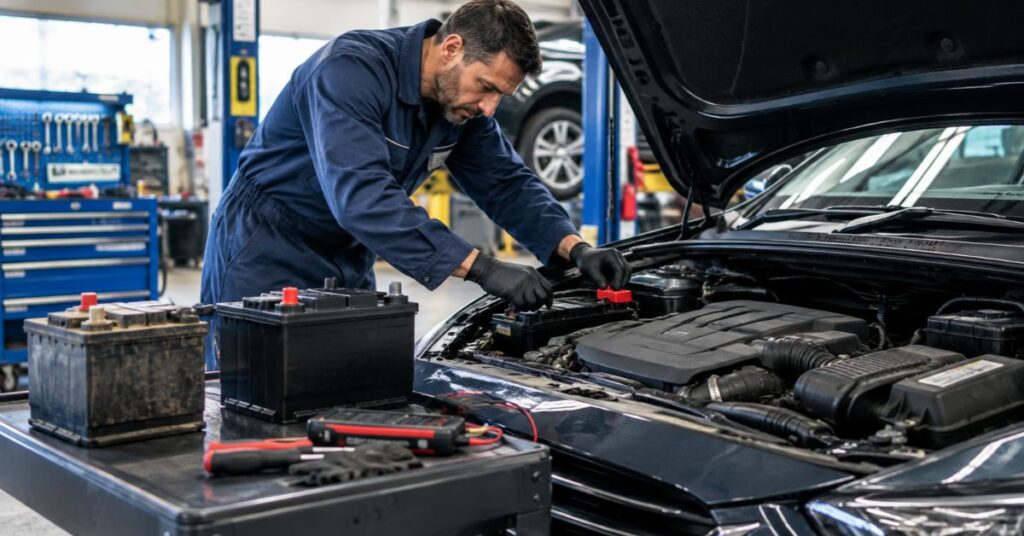
Mechanic inspecting and replacing a car battery during vehicle maintenance
A reliable car battery is essential for starting your vehicle and powering its electrical systems. When it begins to weaken, symptoms such as slow engine cranking, clicking when starting, dim headlights, or electrical glitches can signal that a replacement may be needed.
Recognising these warning signs early can help prevent an inconvenient breakdown and unexpected repair costs. If you’re unsure whether your battery needs replacing, a trusted car battery service can help assess its condition and recommend the correct replacement.
This car battery replacement guide explains how to check battery health, choose the right battery, understand fitting requirements, and extend the life of your new battery.
When Does a Car Battery Need Replacing?
A battery does not always fail without warning. Common signs of a bad car battery include:
- The engine cranks more slowly than usual
- You hear a clicking sound when trying to start
- Headlights or dashboard lights appear unusually dim
- Electric windows or infotainment systems operate slowly
- The battery or charging-system warning light appears
- The vehicle needs repeated jump starts
These symptoms can indicate a weak battery, although problems with the alternator, charging system or electrical connections can produce similar signs. A battery test can therefore be useful before buying a replacement.
How Long Does a Car Battery Last?
Most 12V car batteries typically last around three to five years, but there is no fixed replacement interval. Climate, driving habits, vehicle maintenance, battery quality and how the car is used can all affect lifespan.
Frequent short journeys can prevent the battery from receiving enough charge, while long periods of inactivity can also contribute to battery discharge. Modern vehicles with stop-start technology and numerous electrical systems can place additional demands on the battery.
If your battery is approaching the end of its expected life and you are already noticing starting problems, having it tested is sensible.
How Can You Check Your Car Battery’s Health?
A basic inspection can provide useful clues before you arrange a car battery replacement.
First, look for corrosion around the terminals, damaged cables, cracks or swelling in the battery casing. A damaged or swollen battery should not be handled casually; professional assistance is the safer option.
You can also use a suitable voltmeter or multimeter to check battery voltage with the vehicle switched off. A fully charged conventional 12V battery will generally show around 12.6V, although voltage alone does not provide a complete assessment of battery health. A proper load or battery test can determine whether it can hold and deliver sufficient power.
If a battery repeatedly goes flat, investigate the underlying cause rather than simply replacing it. An alternator fault, parasitic electrical drain or poor connection could be responsible.
How to Choose the Right Replacement Battery
Choosing a replacement car battery is not simply a matter of buying one that physically fits. The battery needs to match your vehicle’s required specification.
Check the manufacturer’s specification
Start with the owner’s handbook or vehicle manufacturer’s information. You can also use a reputable battery supplier’s vehicle lookup tool, but always confirm the specification before purchasing.
Match the size and terminal layout
The replacement must fit securely in the battery tray, with the terminals positioned correctly. A battery that is too large may not fit, while an incorrectly positioned terminal can prevent the cables from reaching safely.
Check the electrical specification
Important specifications can include:
- Voltage
- Battery capacity
- Cold Cranking Amps (CCA)
- Battery dimensions
- Terminal position
CCA is particularly relevant to starting performance, especially in colder conditions.
Choose the correct battery technology
Different vehicles may require different battery types. Conventional lead-acid, AGM (Absorbent Glass Mat) and EFB (Enhanced Flooded Battery) batteries are designed for different applications. Vehicles with stop-start systems or higher electrical demands may require a specific battery technology.
Fitting the wrong type can affect vehicle performance and, on some modern vehicles, may require electronic battery registration or configuration after installation.
How Much Does Car Battery Replacement Cost?
The car battery replacement cost varies according to the vehicle, battery type, brand, specification and fitting requirements. Standard batteries are generally less expensive than premium AGM units, while some vehicles require more specialised batteries or electronic configuration.
Don’t compare batteries on price alone. Check the specification, warranty, expected suitability and fitting cost to understand the overall value. Current UK guidance also shows that replacement prices can vary considerably between vehicles and services.
Can You Replace a Car Battery Yourself?
A conventional 12V battery can sometimes be replaced by a competent DIYer, but modern vehicles can have additional electronic requirements. If you are unsure, professional fitting is the safer option.
The general replacement sequence is:
- Switch off the vehicle and remove the keys.
- Locate the 12V battery.
- Disconnect the negative terminal first.
- Disconnect the positive terminal.
- Remove the securing bracket and old battery.
- Clean the tray and inspect the connections.
- Install and secure the replacement.
- Connect the positive terminal first, followed by the negative.
- Start the vehicle and check that everything operates correctly.
The negative-first removal and positive-first reconnection sequence is also recommended in current RAC and Auto Express guidance.
Always follow the vehicle manufacturer’s instructions and wear appropriate protective equipment. Battery acid and electrical connections can present safety risks.
How to Extend Your New Battery’s Life
Once you have installed a new battery, a few simple habits can help protect it:
- Avoid leaving lights or electrical equipment switched on unnecessarily.
- Keep battery terminals clean and connections secure.
- Avoid repeatedly making only very short journeys where possible.
- Consider an appropriate battery charger or conditioner if the vehicle is stored for extended periods.
- Have persistent charging or starting problems investigated promptly.
Regular checks can help identify corrosion, declining battery health and other problems before they result in a breakdown.
What About Hybrid and Electric Cars?
Hybrid and electric vehicles can also have a separate 12V battery that powers electrical systems. However, this should not be confused with the high-voltage traction battery used to propel the vehicle.
While a 12V battery may be replaceable, never attempt to work on a high-voltage EV or hybrid battery system yourself unless you are properly trained and equipped. High-voltage components can be extremely dangerous, so specialist work should be left to a qualified professional.
Car Battery Replacement FAQs
How do I know if my car battery needs replacing?
Slow starting, clicking, dim lights, electrical problems and repeated flat batteries are common warning signs. A battery test can help confirm the problem.
Should I replace my battery after five years?
Not necessarily. Three to five years is a common lifespan range, but actual battery life varies with usage, climate, maintenance and vehicle demands.
Can I fit a different battery type?
Only if it meets the vehicle manufacturer’s requirements. Stop-start and high-electrical-demand vehicles may require specific battery technology.
Does a new car battery need coding?
Some modern vehicles may require battery registration or electronic configuration after replacement. Check the manufacturer’s requirements or ask a qualified technician.
How should I dispose of an old car battery?
Don’t put it in ordinary household waste. Use an appropriate battery recycling facility, parts retailer or garage that accepts old batteries.
Bottom line
Replacing a car battery is not just about buying a new unit when the old one dies. Recognising warning signs, testing battery health, matching the correct specification and maintaining the replacement can help keep your vehicle reliable and reduce the risk of an unexpected breakdown.
For a deeper look at the process, see our guide on How Vehicle Diagnostics Work in the UK